AGENDA
LA CENTRAL DEL CIRC
TRAINING
CREATIVITY AND RESEARCH
The objective of the Transits residency program is to offer support to the companies that are in need of a physical space and support to carry out their artistic projects (research, creation, rehearsals, etc.), encouraging artists to take a more active approach to research and challenge their work.
In order to meet the needs of the stage in which the creative process of an idea or project finds itself, and enable true progression, we’re proposing various residency formats, accessible to artists and companies following a public call held in November.
However, the format and conditions of the residencies evolve each year, in order to maintain their relevance and be up to date with contemporary circus reality.
Here you can read the rules and requirements of the last public call.
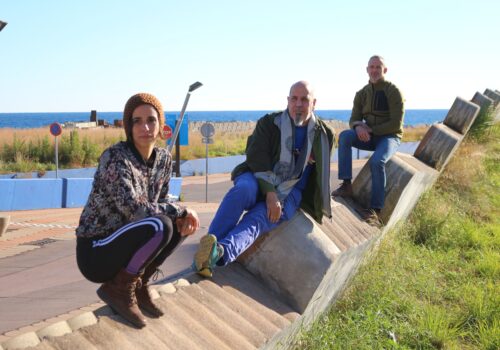
Circus artists Tona Punsola and Jordi Puigoriol, from La Bel·Bel Company, and dancer and choreographer Jordi Cortés, from Liant la Troca Company, come together to carry out the community-based stage creation project Boxa, Cells and Other Stories, which involves the participation of a group of twelve people from the Joia Foundation.
Through circus and dance, the project works with memories, recollections, and fragments: intimate and shared stories that appear, disappear, and are recomposed, like cells in constant transformation. A process of collective research in which the body becomes a living archive. Memory is the red thread that runs through the creation: what is inscribed in the body, what persists, what fragments and is rewritten. Boxa, Cells and Other Stories highlights collective creation as a space for encounter, listening, and expression.
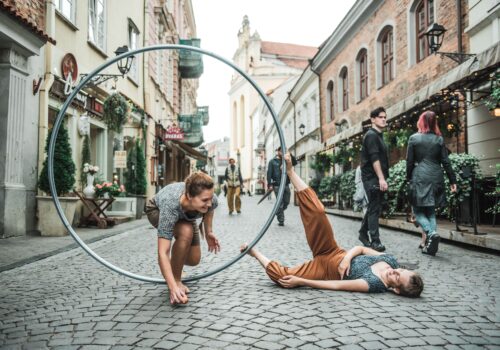
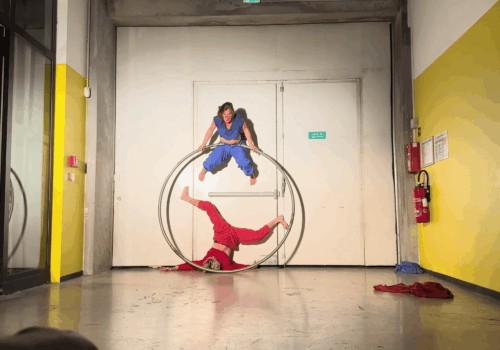
Cherry Matakila is a company formed by Barbara (Argentina) and Simona (Switzerland), who met during their training at Ésacto’lido (2021–2024). Three years of sharing intimate and challenging moments brought them together, and little by little they felt the desire to create together. Bleu et rouge is their first creation.
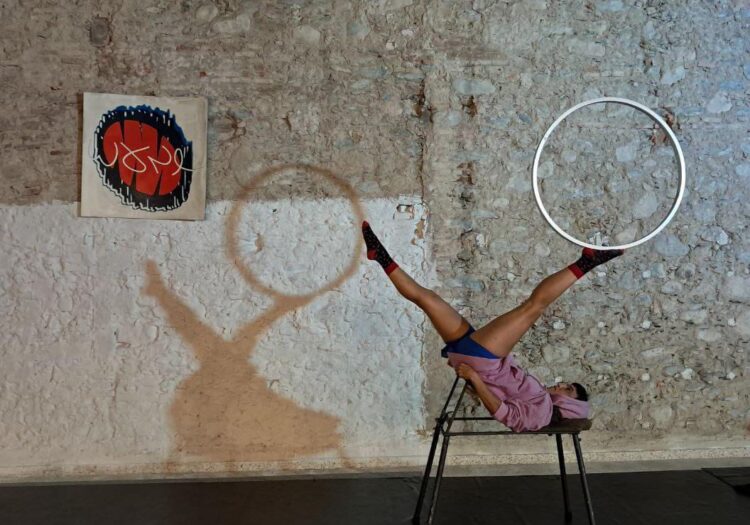
The creation starts from a limitation: what happens when you place a cyr wheel in a 2×3 space? And what happens to the rest of the elements of the space and to the characters that inhabit it? Barbara and Simona embark on this first project together: a playful exploration with circus and absurd humor as protagonists, reflecting on the limits of time and space.
She holds a degree in Fine Arts (University of Barcelona) and in contemporary circus (Fontys University in Tilburg, the Netherlands). She is interested in new formats, the use of digital tools, and hybrid performance scenes. Her artistic practice is interdisciplinary, and she often collaborates with artists from other artistic disciplines, as well as with different fields of research and creation. Among the projects she has developed are Hedonia, a contemporary circus piece combining video art, technology, rap, and electronic music (finalist at circusnext 2023); Baby don’t hurt me, a site-specific itinerant proposal in public space, part of the European platform Hand to Hand; and Two Match, from the Match project, recently premiered at the FAACCC festival.
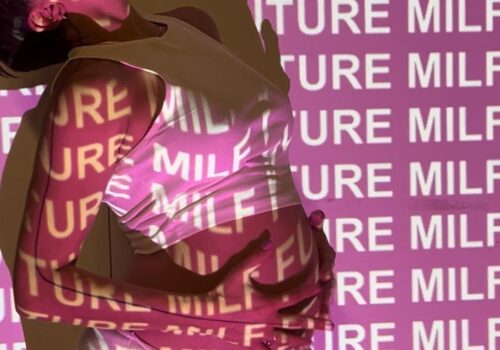
She is currently creating Milf, a contemporary circus performance led by a pregnant woman that combines trapeze, documentary theatre, twerk, and audiovisual elements. Through an interdisciplinary language, she shares the experience of pregnancy in an intimate and visceral way. The proposal transforms a personal experience into a collective and feminist reflection on the body, identity, and sexuality during pregnancy.
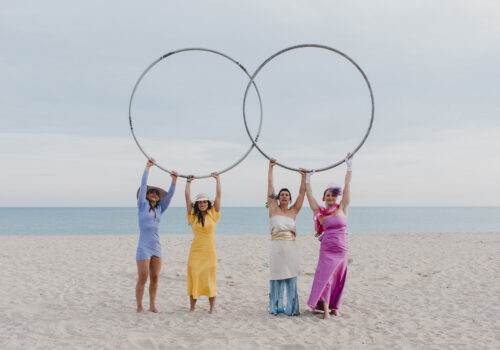
Kolektivo Konika is a circus-theater company established between Italy and Spain, composed of Candela, Elisa, Greta, Naikel, and Michela. In 2018, they came together to share their passion for hand-to-hand acrobatics and make this project a reality, initially based between the Basque Country and Catalonia. In March 2021, they premiered La punta del meu nas, a show that has been awarded both in Italy at “Trampolino Vetrina 2022” and in Spain with the “Festival Territori Violeta 2022” Award. In 2024, it will be the final year of the tour for La punta del meu nas, which has had over 80 performances since its premiere, and the beginning of their second production: Matrimonio.
The current work reflects on the coexistence between traditions and modernity today. It does so through a very old ritual: marriage. Matrimonio is a comedy disguised as a tragedy, disguised as a ceremony, disguised as circus. A look at the black-and-white nature of this ancient and universal institution through circus techniques: acrobatic doors, cyr wheel, balancing, and humor. A street performance where the language is physical, acrobatic, and absurd.
OLGA_cirqAnalogique is a Uruguayan-Catalan company based in Barcelona, formed by Cata Aguayo and Alejandro Dutra. The artists founded the company in 2018 after training at Le Lido – The National Circus Arts School of Toulouse. At OLGA, circus, dance, and music converge to create a hybrid and sensitive language. Their driving force is to transform personal experiences into universal symbols. As migrant and queer people, they understand the stage as a space for representation, resistance, and possibility.
In Utopia for a Ruined Landscape, their second show, they reflect on the end that awaits us as humanity. The end is revealed, and with it, the possibility to live it as we wish. Everything we know crumbles, and with it, our cages. We choose to build a space in which to reconcile with who we are; a present where, even if just for an instant, freedom is possible. Utopia for a Ruined Landscape constructs ways of receiving the end: circus as a poetic, relational, and performative ally; objects as metaphors and music as landscape. The last song, with its last dance.
Anna Pascual and Wanja Kahlert are two artists and co-founders of the company Psirc. Since its creation in 2011, the company has developed several performances, exploring and defining its own circus language. In addition to performing on stage, they have taken on other roles within the creative process of other projects. The core of their work is their love for beauty, humor, mystery, and art as a way to intuit a reality beyond the human scale. Rolando San Martín is a multidisciplinary artist dedicated to the direction and dramaturgy of performing arts projects. His close relationship with Psirc began with the creation of El meu nom és Hor and continues with the performance saga Després de tot. His work as a director and dramaturg is linked to creation and processes that generate language, exploring the friction between different artistic and intellectual disciplines.
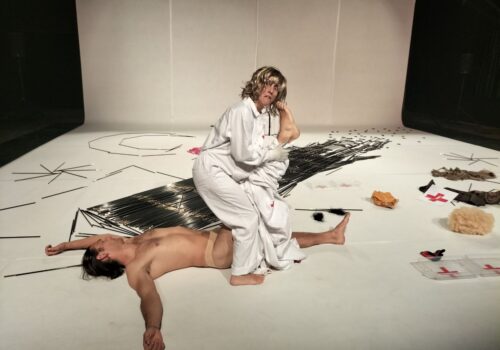
In their current project, La casa intempèria, two acrobatic door artists, globally known in contemporary circus, experience an earthquake during the performance. They find themselves stranded, without a show, without a house, without a home. After assessing the pain from the wounds received, both physical and emotional, the disaster’s health authorities mandate the use of clowns to heal. Both characters become aware of their existential failure: they realize they are absurdly trapped inside a space with invisible walls. Desperate, they seek a way to escape this glass cage. In the open air of this abyssal interior, two clowns try, with 2,000 tent poles, to build a house to save themselves.
Maria Solà (1981, Catalonia) creates disjunctive work to denounce the dysfunctions of the system. She is connected to the Catalan and Danish underground, producing festivals, performances, exhibitions, and publications in defense of counterculture. Regarding the performing arts, she is an interpreter and producer. She co-founded Las Feas (2002-2006) and The Brunette Bros (2008-2020). Since 2023, she has performed solo with Mama Calypso and Fets Reals. In the visual arts, she is a researcher and photographer. She carries out publications, exhibitions, and short films.
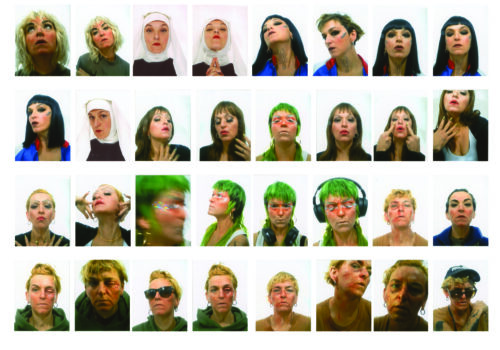
Her current project, Nacionalidad española: trampas, evidencias y fotos prohibidas, is a critique of police protocols, identity boundaries, the veracity of photography, and control systems. It is also an ode to drag and a testimony to the flexibility of gender expression. It is an evidence, a daring act, and a conquest. A cross-disciplinary research between visual and performative arts that she has carried out over more than two decades, marking her artistic identity specialized in clowning.
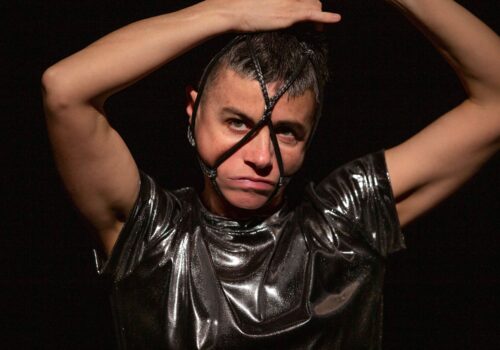
Victoria Sickness is a multidisciplinary artist whose career combines technique, creation, and scenic research. She trained in circus arts at the Centre de les Arts del Circ Rogelio Rivel and in Image and Sound Engineering. Since 2017, she has been the lead vocalist and tenor saxophonist of the band Las Marikarmen. In parallel, she leads her own company, Cia. Victoria Sickness, which is currently developing a scenic research project on the travesti body in circus.
Her artistic practice explores the limits of movement, gender, and queer expression, connecting disciplines and creating dialogues with audiences from an experimental and avant-garde perspective.
In the project Algunis no tenim l’opció de no posar el cos, the artist proposes a scenic research process that starts from a quote by Roberta Marrero: “Some people cannot afford the luxury of not putting their bodies on the line.” She explores how a travesti body inhabits risk, fragility, and humor through a combination of scenic languages that challenge hate-driven discourses. The process is complemented by archival research on travesti figures in the performing arts in Spain, generating an open dialogue with all audiences as well as with public space.
The company founded by Clara Poch and Marçal Calvet was born in 2008 and has developed its own language combining circus, theatre, dance, and live music. Their creations —Merci Bien, Amigoo, Flou Papagayo and Lady Panda— have been presented in numerous countries and festivals such as Fira Tàrrega, Trapezi Reus, Fira Mediterrània de Manresa, Umore Azoka, Fira de Circ de la Bisbal d’Empordà, La Strada (Austria), Vivacité (Belgium), and Chalon dans la Rue (France), among others. Their work is characterized by the integration of live music, visual poetry, and a humanistic approach to the body and risk.
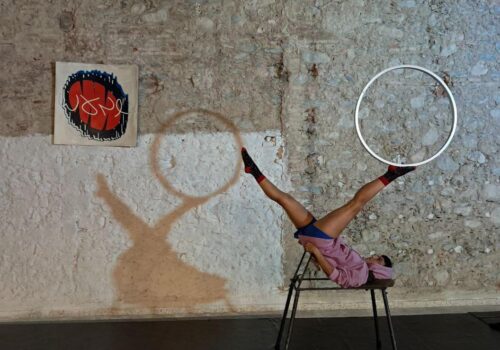
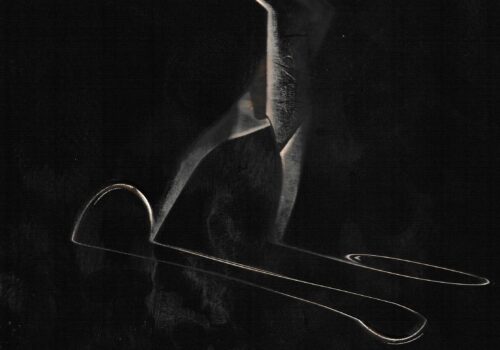
Currently, they are in the process of creating L’Ombra de la Libèl·lula, a contemporary circus and visual poetry piece that explores fragility, memory, and the transformation of the body. After an injury forced a redefinition of stage presence, the company builds an intimate universe where light, sound, and movement interact to reveal the beauty of change—a symbolic journey toward the light that emerges from the shadow.
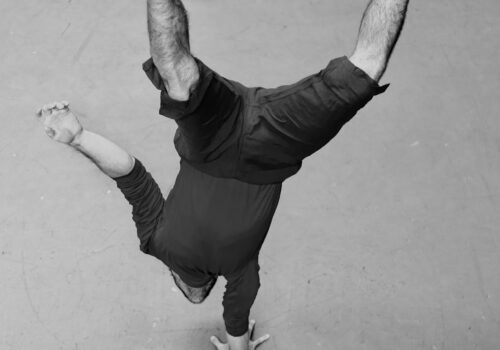
Luis Mantilla, originally from Guayaquil and currently living in Mendoza, began his journey in movement through gymnastics and later ventured into circus, specializing in handstands. In 2020, together with Julieta Tissera, he founded Proyecto Recóndito, a duo dedicated to movement research, with which he has participated in international festivals and workshops. In addition to being a teacher and former director of Cos Invertido, he currently teaches virtual classes and develops Vestigios, a project focused on the artistic and emotional exploration of movement.
‘Vestigios’
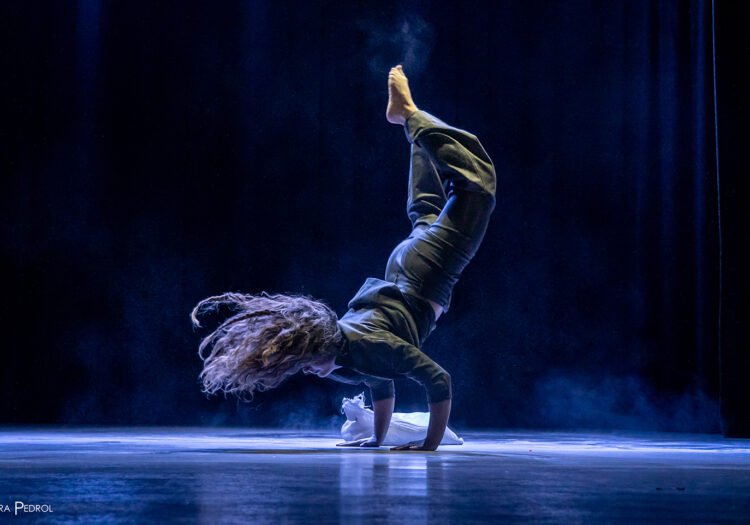
Vestigios investigates handstands from an artistic perspective, questioning their form, meaning, and purpose. It proposes shifting technique from the standard toward invention, understanding movement as a living relationship between body and action. In this approach, technique loses value for its formal perfection and gains it for its poetic power and its ability to create meaning within the work.
Artist in residence at La Central as part of the Iberescena program.
Croma is a contemporary circus company that fuses circus techniques, dance, and theatre to create innovative stage productions. Their work is characterized by the use of object manipulation and the exploration of materiality, generating a unique artistic language.
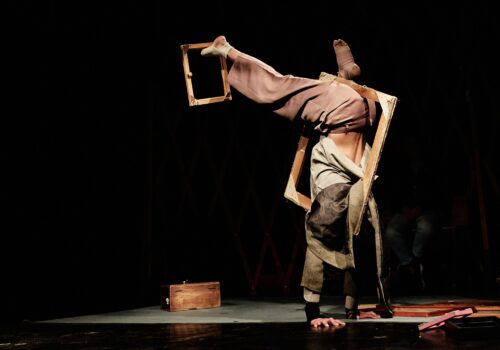
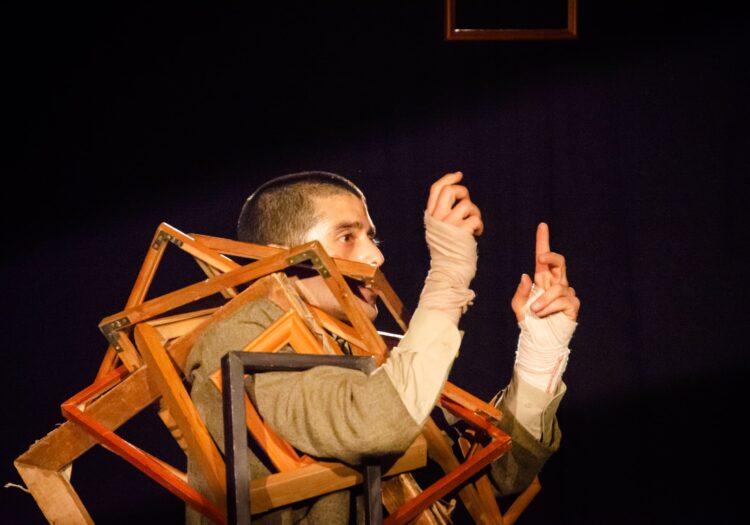
Efraín Salazar is a performing artist and creator linked to contemporary circus. His work focuses on the exploration of the body, the object, and memory, investigating the intersection between circus, dance, and theatre. He has developed original works such as Ensayo y error, Solo un marco, Alguna vez fui — the latter delving into the relationship between identity and memory through the manipulation of empty frames without images. He has collaborated on various collective projects related to the performing arts between the Valparaíso and Metropolitan regions, contributing his creative and technical perspective.
“Alguna vez fui”
A contemporary circus piece that explores the fundamental role of memory and recollection in the construction of our identity. Through contemporary circus and its combination with other techniques such as dance and object manipulation, the piece tells an intimate and emotional story, inviting the audience to reflect on how past experiences and memories shape who we are.
Artist in residence at La Central as part of the Iberescena program.
Cia Totapedra is a contemporary circus company created in 2025 by Andreu Casadellà and Júlia Clarà, with the aim of developing the show Pífia.
The name comes from the saying “Tota pedra fa paret” (“Every stone makes a wall”), symbolizing the importance of every small gesture or contribution.
Pífia
Pífia is a contemporary circus show currently in creation. From the absurd gesture and tenderness of clowning, we offer a poetic and critical perspective on the world of work and our place within a system that demands more than we can sustain.
With a close, accessible aesthetic and dramaturgy rooted in the body, risk, and physical comedy, we seek to bring out the humanity found in imbalance, error, and persistence.
An endearing character — a clumsy worker in a space under construction — tries to keep order in a world that is collapsing around him. And he will do so with the help of an audience that, without realizing it, becomes an active part of the performance.
In residence as part of the EKO – Pirineus de Circ program.
After 20 years of practicing juggling, Edu has developed his own style that combines circus, dance, and theater. He has trained with renowned artists such as Stefan Sing, Gandini Juggling, and Roberto Magro, and has worked with numerous circus and street theater companies, both in Spain and internationally. Currently, his work focuses on the companies Alodeyá Circ Dansa and Edu Manazas. His work has been recognized with several awards, including the Festival Off de Calle Pilares 2015 and awards for Son Recuerdos and Fuera de stock in national and international competitions.
‘Meraki’
Time passes inexorably. And with it, life goes by. We try to control what happens around us. And in this impossible attempt, we forget to enjoy the unpredictability of life. Putting our soul, time, and love into what we do becomes an act of rebellion. Meraki speaks to us about meticulousness, creativity, and passion in our actions, about cultivating and putting our essence into what we do to leave our own mark and have that mark remain in our life. Before time runs out.
In residence at La Central del Circ, within the framework of the EKO-Pirineus de Circ project.
Aïna Duc is a member of the TBTF collective, based in Bourg-Saint-Andéol, a group of 20 artists who seek to build collectivity in a divided society. She graduated from ESACTO-LIDO in 2023 and has since explored public space with the company Sept fois la langue and hospital clowning with Soleil de clown. Les péripéties du dedans is the natural continuation of her love for clowning and aerial fabric.
‘Les péripéties du dedans’
A clown and a fabric. Les péripéties du dedans is a daring and joyful immersion into the paths of everything that submerges us.
In residence at La Central del Circ, as part of the Cross Residencies with La Cascade.
Teatronas is one of the main organisations in Lithuania that strategically develops the field of contemporary circus in Lithuania and the Baltic region. Apart from development projects and the international contemporary circus festival Cirkuliacija that happens each year in various cities in Lithuania, Teatronas has combined their knowledge in theatre and circus and since 2024 started creating circus-theatre shows. These are created by the artistic director Gildas Aleksa and local circus artists as co-authors. It creates a possibility to have more job opportunities for the artists and develop new audiences for circus.
The 2025 production “Šarūnas” is aimed to find the combination of the old drama traditions of Lithuania and the new circus writing of contemporary artists.
In residence at La Central del Circ within the framework of the Crossed Residencies with Arts Printing House.
Capicua Company has a career spanning more than 20 years at both national and international levels. Among its creations are Cabaret (2010), Entredos (2013), and Koselig.
Its main awards include: Jury Prize at OFF El Pilar in Zaragoza (2009), Audience Award at the Street Theatre and Circus Arts Festival of Ávila (2011), Audience Award for Best Theatre Performance at the International Theatre and Dance Fair of Huesca (2013), Career Award from the Aragonese Circus Company (2014), Territorio Violeta Award (2023), and the Marcelino Orbes Award for Best Aragonese Circus Show (2023).
The company is made up of Yolanda Gutiérrez Encuentra, Rebeca Gutiérrez Encuentra, María de la Paz Arango Quiceno, Miguel Ángel García García, and Irene Estradé.
RUTA
RUTA is a contemporary circus proposal characterized by the use of circus techniques, sound art, and cinematographic language. The main theme of the piece is the encounter between two cultures and two opposing ways of life. On the one hand, the sedentary, who live relatively rooted in one place where few things change. On the other, the nomads, who live in constant movement and transformation.
Juan Fresina Scotto is an Argentinian performing artist specializing in the intersection of contemporary circus and science. His work as a performer and creator explores these connections in pieces such as Qua, Ensayo para a Desorden, and his latest creation, Infinito. This new project, directed and performed by Juan Fresina Scotto alongside Pablo Melo and José Cereceda, specialists in aerial straps, continues his collaborative approach, integrating scientific knowledge and circus techniques to foster an innovative and poetic dialogue between the two disciplines.
In residence at La Central del Circ as part of the cross-residency program with Erva Daninha (Portugal).
HERTZ is the first long-duration creation by Cie Dissociée, following Pacemaker, and explores the themes of fakirism and clowning. Released in February 2024, this piece, suitable for all audiences from the age of 10, integrates theater, performance, and installation. At the center of the stage, a pile of crushed glass measuring 7 meters by 5.5 meters, weighing over 800 kg, interacts with dance movements and acrobatics. The performance questions the limits we impose on ourselves, addressing themes such as pain, resilience, and the boundaries of the impossible. By intertwining fakirism and clowning, HERTZ highlights human contradictions, inviting the audience to embrace their weaknesses and discover a more authentic and resilient humanity.
Marcelo Nunes is an author and performer whose artistic career is based on a constant search for novelty, influenced by his experiences in Brazil and Europe. His practice focuses on three techniques: trapeze, clown, and fakirism, exploring the wild nature of humanity. Since his first work, Pacemaker, Nunes has expressed his worldview through a unique artistic language. On stage, he uses the body as a tool for communication, creating an authentic dialogue with the audience. Through his creations, he seeks to foster a poetic resonance between the artist and the audience.
The company was born from the union of four multidisciplinary circus artists based in Euskal Herria (Oihane Larraza, Gaspar Illoro, Zoe Aldekoa, and César López). Their aim is to explore the poetics of the rural world to reach a shared sensitivity through the language of circus. Their main disciplines include aerials, juggling, Chinese pole, Cyr wheel, acrobatics, and dance. They met while attending the technical training program at INAC (National Institute of Circus Arts) in 2018, in Portugal. After separating and continuing their professional training independently, the artists decided to reunite and create the show Herrari. Driven by shared interests in contemporary language, they work by taking artistic risks rooted in emotions and sensations to engage the audience.
‘Herrari’
Herrari is an itinerant contemporary circus show that invites us to reflect on natural and rural spaces, which have changed significantly due to human presence and, paradoxically, its absence. It delves into the nostalgia for rural life, sparked by the longing for calm and a sense of community in today’s world. Life in cities is becoming increasingly unsustainable due to factors like gentrification, which disrupts collectivity, stripping places of their identity and further severing our connection with nature. The show seeks to build a bridge between rural and urban spaces, fostering a symbiosis between the two. It aims to propose alternative ways of living that are sensitive to the environment, encouraging us to be an active part of the world around us.
Elisa Oliva discovered her love for circus arts while attending film school in London (2016-2018). After completing her studies in the seventh art, she decided to pursue a professional course as a circus artist at Flic Contemporary Circus School (2019-2020), specializing in aerial rope. During that year, she began exploring creative possibilities by incorporating a skateboard into aerial rope performances. After working as a teacher and performer for the Circo all’Incirca company (2021), she decided to move to Barcelona in 2022 to continue teaching and developing her project, TreNotturno, in the European capital of skateboarding.
TreNotturno is a solo that uses the language of circus and urban art to create unusual chimeras. Two apparatuses apparently at antithesis, an aerial rope and a skateboard, meet to generate a hybrid dialogue. TreNotturno is a journey through the night that takes us to horizons that are as much interior as exterior, a railway that loses itself in distorted shadows and ephemeral light. Episodic and non-linear, it is an invitation to listen to our shadows and to see more clearly what is invisible during the day.
Gabbie is a dance and circus artist who works as a performer, teacher, stage director, and movement director. She specializes in contemporary dance, acrobatics, and Chinese pole, with over 10 years of stage experience. Throughout her career, she has collaborated with several dance, circus, and physical theater companies, covering a wide variety of performance genres. She has toured both nationally and internationally, performing for theater audiences, street theater festivals, and under the circus tent at various festivals.
Her workshops on acrodance and Chinese pole have been sought after by various higher education institutions and professional companies, such as the Institut del Teatre (Barcelona), CREAT (Valencia), Movement Andalusi (Granada), UNSAM (Buenos Aires), Accademia Dimitri (Switzerland), 2Faced Dance, and NoFit State Circus (United Kingdom).
Girl with a Curl
Girl with a Curl is a fantasy about power and liberation. It delivers a public service announcement on how women have historically been taught to ignore and internalize their anger, conveniently sustaining the patriarchy and ensuring that violence remains on the side of the oppressor. This multidisciplinary and immersive solo piece combines Chinese pole, contemporary dance, acrobatics, physical theater, and text/comedy. The work is comedic, absurd, and carries a strong political charge.
Hristina Šormaz began practicing circus and focusing on aerial rope while studying scenography in Belgrade. She trained as an artist through non-formal education, artistic collaborations, and masterclasses in circus and contemporary dance. She is a member of the Cirkusfera association, dedicated to the development of the contemporary circus scene in Serbia and the region.
Discovering different physical practices became for her a way to question human relationships with their environment and society, which led her to engage in artistic, pedagogical, and social work driven by circus. Since 2018, she has been pursuing doctoral studies in scenography, where she investigates the use of space and matter from a circus perspective.
Currently, she is based in France, where she continues to work in the circus field, as well as in Serbia and Croatia.
‘Traces’
Mariana Fernández is a performing artist specializing in aerial acrobatics and contemporary dance. She has worked with circus and dance companies such as Cirko de Mente, Inside the Body, and Cia. Cracoviana, and has collaborated with the company NonGratos Teatro. As an independent artist, she has participated in international festivals and is the co-director of Mujer Barbuda, Women in Contemporary Circus. Additionally, she co-created projects like Colectiva 9 Gramos and currently directs the company Otra Vez Lunes. She has also been an international teacher and workshop facilitator in the field of circus arts.
La casa está en llamas
La Casa está en Llamas is a project that celebrates functional diversity as a powerful way of living and transforming the world. Using tools from circus, dance, theater, and visual arts, workshops and dynamics will be conducted to highlight the participants’ perspectives, revealing their transformative potential. In a safe space, topics such as self-perception, recognition, self-validation, and personal desires will be addressed, emphasizing the value and creativity of our differences. The circus concept of risk will be used to create performative spaces that will showcase the final proposals.
Morgana was born in Bologna in 1995, with a twin sister. After training in rhythmic gymnastics and studying Psychology at the University of Bologna, she discovered contemporary circus. She trained at the FLIC Circus School in Turin, where she studied clowning, contortion, and contemporary dance. She also obtained a master’s degree in Psychosomatics at the Villaggio Globale in Bagni di Lucca. In 2022, she founded the street circus and theater company Le Vamp and, eventually, resumed playing with Barbies, becoming Miss SBarbie.
Miss SBarbie
Once upon a time there was a plastic body. Maybe 2, maybe 10, maybe a 100… Or maybe a 101! There were once a lot of little cyborgs that brightened the lives of little girls, allowing them to imagine all the possible worlds, places, and moments that those inanimate creatures could materialize and experience. There’s Morgana. And there are the Barbies: my friends, my doubles, my audience, my enemies, my superpowers, my bullets… There’s Franchina, the automated car… And, of course, there is Ken… Human!
Open registrations for the P.L.A.T on November 20 with Cia. Croma and Luis Mantilla
Resolution of the call for the Transits Residencies 2026 and the ‘Barcelona Crea Grants – Creation Factories’
Open call to participate in CirCulem 2026/2027
Open Call – Trànsits 2026 Residency Program, supported by the ‘Barcelona Crea Grants – Creative Factories’
Resolution of the 2025 Iberescena Program Call for Proposals
“Can We Create Without Memory?” Check out the 2025 fanzine!
MEDIATION