AGENDA
LA CENTRAL DEL CIRC
TRAINING
CREATIVITY AND RESEARCH
The objective of the Transits residency program is to offer support to the companies that are in need of a physical space and support to carry out their artistic projects (research, creation, rehearsals, etc.), encouraging artists to take a more active approach to research and challenge their work.
In order to meet the needs of the stage in which the creative process of an idea or project finds itself, and enable true progression, we’re proposing various residency formats, accessible to artists and companies following a public call held in November.
However, the format and conditions of the residencies evolve each year, in order to maintain their relevance and be up to date with contemporary circus reality.
Here you can read the rules and requirements of the last public call.
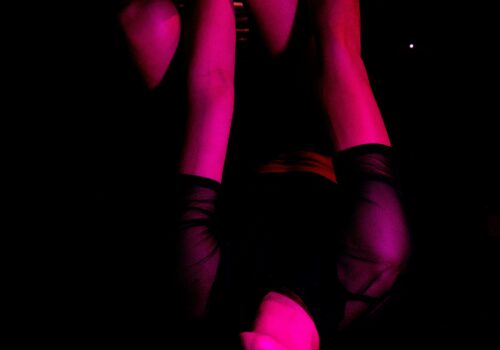
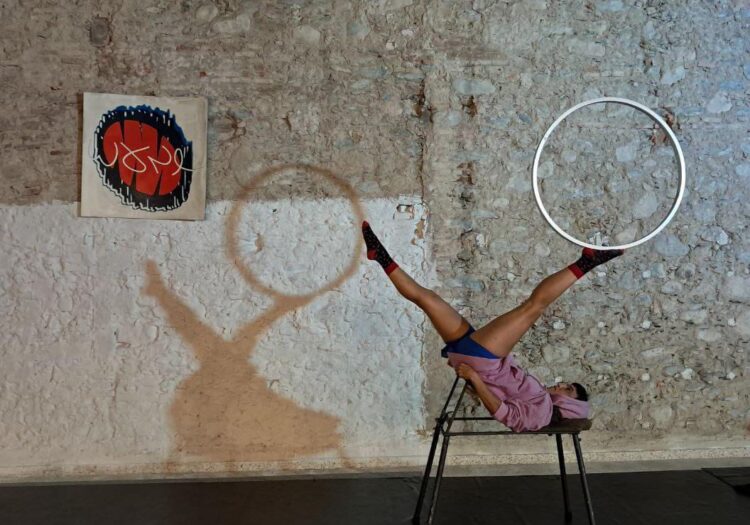
Antonia Solano began her career in the circus world in Málaga, her hometown, and continued it in Barcelona. She is self-taught in the art of antipodism and the creator of La Querida Compañía. She is currently part of the Truca Circus Company.
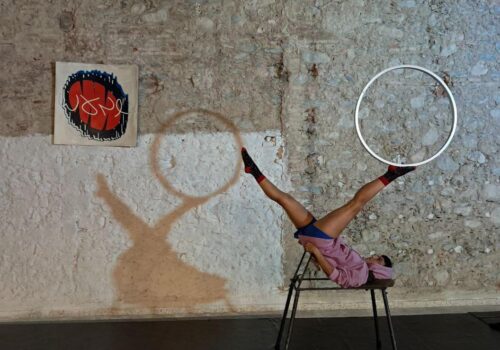
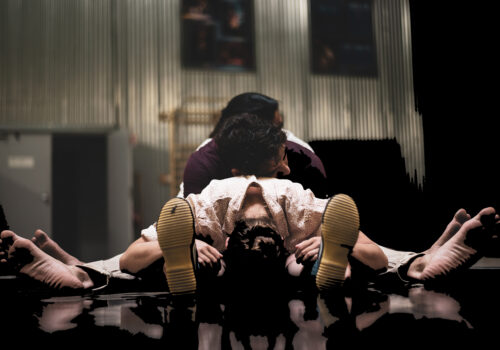
The Decúbit project takes the word antipodism as its starting point, from which the idea of the opposite emerges as a driving force for research. It focuses on working with the trinka and how its use affects the body and the stage, exploring new relationships between technique, object, and stage perspective.
Ginés Belchi Gabarrón is a floor acrobat and, since the age of 15, has been in love with the body and its possibilities. He works with the language of acrodance, physical theatre, and experimental dance. He trained at the Centre de les Arts del Circ Rogelio Rivel and at Ésacto’Lido in Toulouse. He is co-founder of the company El lado oscuro de las flores and has taken part in various projects in Catalonia, such as the Combinat de Circ and the Circ d’Hivern at Ateneu Popular 9Barris. He has also worked with different companies in France.
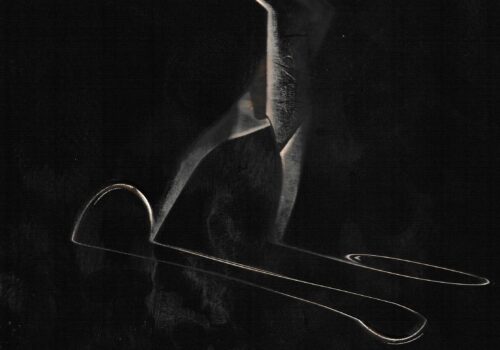
He is currently developing the research project Con placer querida / Complacer qué herida, an exploration through the acrobatic body, physical theatre, and object manipulation —scissors—. Different fragilities, states, and ways of approaching the object raise questions about how the way we relate to ourselves can be more or less dangerous, and how this can affect us in different ways.
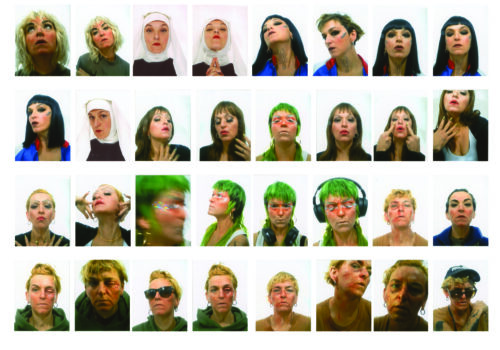
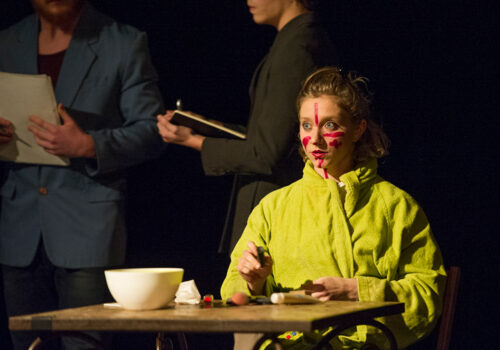
Maria Solà (1981, Catalonia) creates disjunctive work to denounce the dysfunctions of the system. She is connected to the Catalan and Danish underground, producing festivals, performances, exhibitions, and publications in defense of counterculture. Regarding the performing arts, she is an interpreter and producer. She co-founded Las Feas (2002-2006) and The Brunette Bros (2008-2020). Since 2023, she has performed solo with Mama Calypso and Fets Reals. In the visual arts, she is a researcher and photographer. She carries out publications, exhibitions, and short films.
Her current project, Nacionalidad española: trampas, evidencias y fotos prohibidas, is a critique of police protocols, identity boundaries, the veracity of photography, and control systems. It is also an ode to drag and a testimony to the flexibility of gender expression. It is an evidence, a daring act, and a conquest. A cross-disciplinary research between visual and performative arts that she has carried out over more than two decades, marking her artistic identity specialized in clowning.
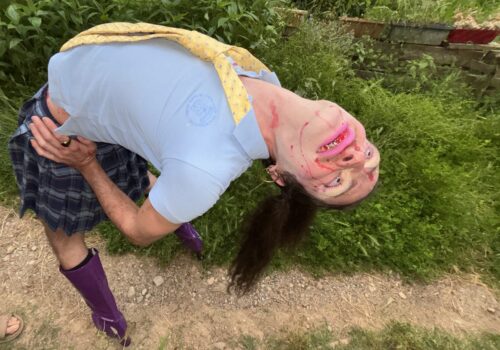
Victoria Sickness is a multidisciplinary artist whose career combines technique, creation, and scenic research. She trained in circus arts at the Centre de les Arts del Circ Rogelio Rivel and in Image and Sound Engineering. Since 2017, she has been the lead vocalist and tenor saxophonist of the band Las Marikarmen. In parallel, she leads her own company, Cia. Victoria Sickness, which is currently developing a scenic research project on the travesti body in circus.
Her artistic practice explores the limits of movement, gender, and queer expression, connecting disciplines and creating dialogues with audiences from an experimental and avant-garde perspective.
In the project Algunis no tenim l’opció de no posar el cos, the artist proposes a scenic research process that starts from a quote by Roberta Marrero: “Some people cannot afford the luxury of not putting their bodies on the line.” She explores how a travesti body inhabits risk, fragility, and humor through a combination of scenic languages that challenge hate-driven discourses. The process is complemented by archival research on travesti figures in the performing arts in Spain, generating an open dialogue with all audiences as well as with public space.
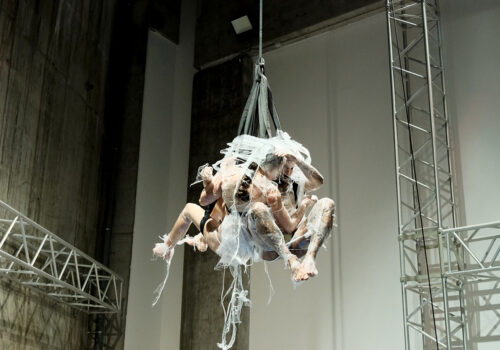
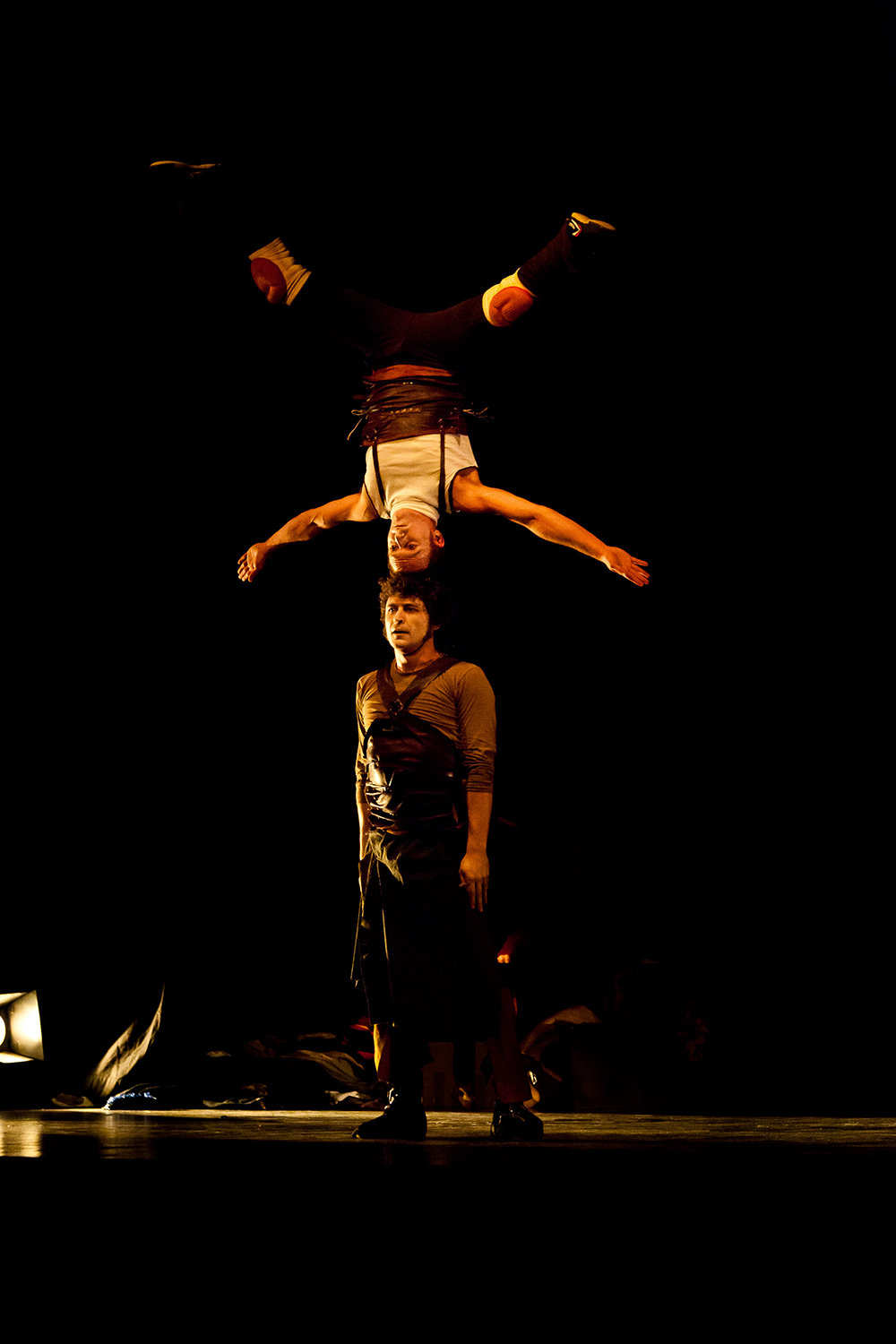
Cie. Le Bar à Chiens is composed of artists Florencia Galimberti, Matthias Elgueta, Lina Ramírez, and Stefano Zacchi, hailing from Chile, Argentina, Colombia, and Italy, brought together by their desire to explore acrobatic lifts as part of the same language.
‘A braccio’
A braccio is a sensory experience that invites the audience to connect with their own emotions and memories, resonating with the deepest parts of their being. A journey where circus becomes the perfect vehicle to explore the depths of the human soul.
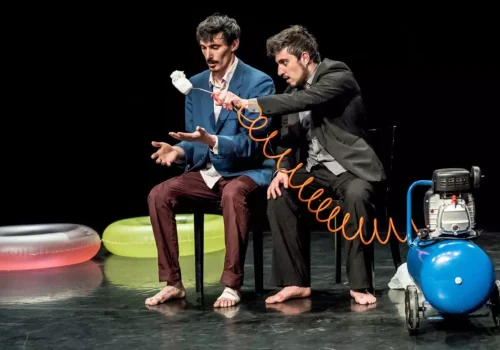
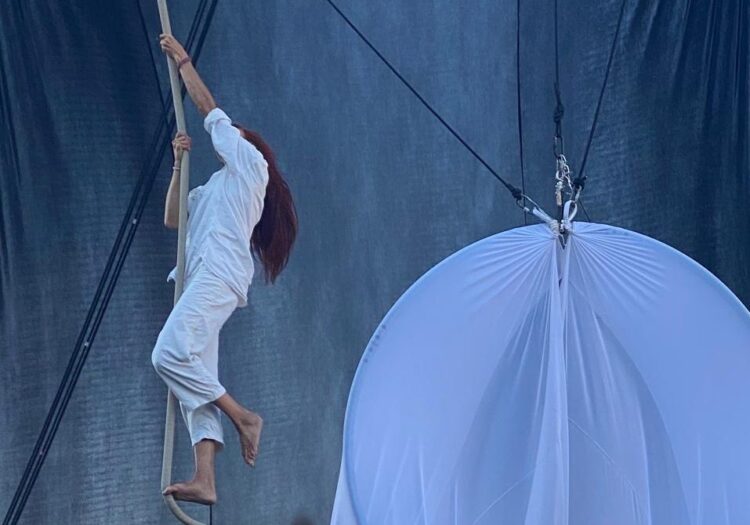
Cía. Mesa para Dos, founded by Bryony Fowler and César Bonilla, is a creative entity forged within mutual coexistence, infused with resilience, humor, community, and the unconventional. The artists’ paths crossed in Turin, where they shared an apartment and specialized in aerial rope at the Flic Scuola di Circo, while life took them down absurd paths that challenged social norms. For their current project, they are working with the artistic guidance of Alejandro Dutra.
‘DesMother’
DesMother is a circus exploration based on the satirical narration of this bond, working between the beauty of the margins and imperfection. Through aerial rope and humor that leans toward the absurd and the poetic, it explores the notions of the dirty, the vulnerable, the familiar, and the strange, the shifting of relationships, and everyone’s expectations in art and life. It celebrates friendship, mutual care as a revolution, and the beauty found in the obscene and in what society rejects.
Maragda Induráin and Maria Estela met and studied at the La Madó Dance School (Vilassar de Mar) from 2015. At the same time, each has been trained in different techniques. Maragda Induráin, contemporary dancer and circus artist, was part of the Cia jove Fre3Bodies 2018, studies at the Rogelio Rivel and dancer at the Cia Roseland Musical. Maria Estela, performer and singer, graduated from the Institut del Teatre, resident at Lo Spazio, research centre and artistic practices, collaborates with national musicians and dancers, and works for the next production of the Teatre Akademia 2024 directed by Moreno Bernardi.
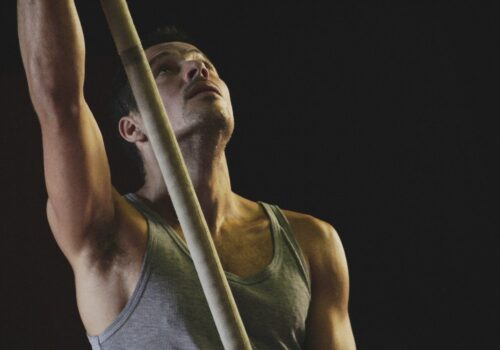
Nowadays they are realizing their first project together, the search of stage poetic between the chinese pole, the voice and the word. We will experiment with possible methodologies based on improvisation and repetition dynamics, in order to enter into what music and movement suggest.
He was born in Friuli, studied graphic design, came to Turin as a juggler but ended up hand in hand. After three years of training at the Flic circus school, he moved to Barcelona, where he improved the hand-to-hand technique and cultivated his artistic side. He has worked on several projects and companies, such as “Viso&Rachel” “Cieocifa” and with the “Fabbrica C” collective.
He currently lives in the fruline mountains where, in Circo all’Incirca, he regularly teaches hand-to-hand classes. He also collaborates as an artist and set designer with the Brocante association and with Roberto Magro. He is also in the process of creating the piece ‘Fragile’.
Fragile
Balance is alive.
A controlled precariousness, where risk suspends us.
And if it falls? doesn’t always matter.
Arrel Guevara studies the degree of Social and Cultural Anthropology in Barcelona while starting to train as a circus artist in different spaces such as Atlantis and Gente Colgada. Later, in 2020, he decided to become an artist at the CAU Circus and Theatre School in Granada, where he specialized in trapezium, and also took a social circus course at the Ateneu Popular 9Barris. Currently, he works as a circus trainer at the Circo Aire and La Volta schools, and continues to train in dance, acrodance, theatre and trapezium. He is in the process of researching and creating his first solo, ‘Lutum’.
‘Lutum’
‘Lutum’ comes out of my ass, but not just from mine; it comes out of the anus as a hole susceptible to violence. ‘Lutum’ is the encircled framework within the body that only needs to be alive to die. It’s the mud entering the veins without asking for permission and taking you to paralysis. It is to tray the bones and organs deposited in a body that is transformable and deciduous. That it is penetrable and impenetrable. Organic and grotesque. Fixed and stroboscopic. Hysteria and white space.
From the most private to the public emergency: sexuality, gender, violence and disease are the elements of the human being that converge in that scenic experience, represented through the body, trapezium, drag and words.
He has had circus, dance, currently two theatre companies; bands, orchestras, dúos and solos. He has been a musician since he has memory, accompanying the creation processes of Losin’Form’Alls, Circ Vermut, Alba Ramió and Ildor Llach, and a string of French companies such as INO Kollektiv. He has worked as a sound technician, light technician, distributed magazines and stacked powdered detergent packages on a pallet in a warehouse. He has also worked as a music teacher.
4A
Ideally it would be a lot of things, objects and techniques and records and shadows; but since it’s a simple inquiry now, I’ll stick to music and circus, mechanics and trajectory.
Cata Aguayo is a multidisciplinary stage artist, researcher and teacher, born in Uruguay. Diploma in circus arts at the University of San Martín, Buenos Aires, and at the higher school of circus arts in Toulouse, ESACTO – Lido. She studies various techniques of contemporary dance and improvisation, specializing in Asymmetrical
Motion, with Lucas Condró. He also studied vocal technique and singing.
In 2018, she created with Alejandro Dutra, the company Olga – Cirqanalogique, finalist at Circusnext 2020-21, winner of the Cross-border Cooperation Fund Travessia Pyrénnés de Cirque and awarded by the Toulouse City Council and the Department of Haute-Garonne. Currently, they are creating their second show. She has been an interpreter for the French companies L’Éolienne and La Grue, choreographer of La June Compagnie and external gaze of several emerging companies. Since 2018 he has been directing the Annual Air Research Laboratory, of La Bonita cooperative.
Pandora
Pandora investigates the gap that exists between the place we are socially attributed to and what we choose to occupy. This margin between what is inherited and what is built. It is born of a desire for reconciliation with one’s own uniqueness, where the personal rebel to thunder universal and political.
Foto: Sofia Chopitea
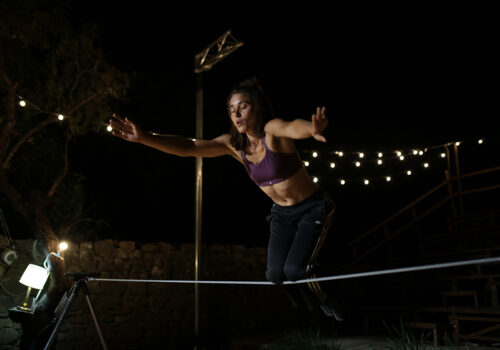
Julia Behar Bonnet is a circus artist, musician, singer and dancer. He trained in staging at the University of Poitiers (France), and in circus at the Rogelio Rivel school in Barcelona, where he specialized in the art of balance on a cable. In 2019 she embarked on several tours with Gommette and Gabatcho Circus (Switzerland) and collaborated with circus artists as a performer, director, external gaze and/or musician. She currently lives in Toulouse and collaborates with different companies (Sweet Xili Circus Company, Nostraxladamus, etc.). In autumn 2023 begins the creation of ‘Tendre’, a solo that mixes circus, music, dance.
‘Tendre’
Everything begins or ends with a tender and violent desire. Deep and visceral. An emergency. To do in common and call this urgent need for tenderness…
Photo: Milki Lee
Cia. La Bel•Bel is formed by Marta Punsola, La Tona, (Cia Zero, Spazio Bizzarro, Cronopis Espai de Circ), and Jordi Puigoriol, el Putxi, (Cie Cirquons Flex, Cie Les Pieds Sur Terre, Cie XY). After their respective training and some professional experiences, in 2023 they exchange artistic ideas and embark together in the creation of a piece that is currently provisionally called ‘Guillem’.
‘Guillem’
Contemporary circus piece narrated in first person. It combines acrobatic balances, movement, text and audiovisuals.
All wounds leave a mark. Sometimes this mark is perceptible and trauma can be recognized as a scar. However, there are experiences that, despite not leaving a physical mark, are housed in the deepest of the soul, hidden in some corner.
The tingling, diplopia and loss of sensitivity corresponds to each of the phases of Guillain-Barré syndrome, which attacks the nervous system. This loss of sensitivity is reflected in parallel with the loss of social sensitivity in all areas.
Even so, light always sneaks through some crack, and therefore, awareness of the wound leads to acceptance and the will to rebuild.
Foto: Oriol Segon
The impetus for this search is a “conatus”: A powerful movement and an appetite which belong to my path-my artistic and personal path. but overall, they belong to my body, and are born from it.
The norm. The norm-alisation. norm-ality. The rule. The rules. The blood. The sacrifice. The holiness. The perfection. The sublime. The terror. The power. The norm. Cyclic. I want to know my body outside of the norms. The techniques. Outside of what is norm-al: norm-al in the way it moves, presents itself, uses itself, stops using itself, speaks, in the circus, in the theatre, in dance, as an image, as an icon, in this political territory which is my body.
I need to investigate the norms which live in me, so that later I might break them. I need a space of solitude, to recognize the formalities and surpass them. I need to identify the imprints which the power systems left in my body, so that I can revolutionise them. I need to know coercion, so that I might give myself to a fertile insurrection.
In 2011 he trains in juggling in Buenos Aires, with Pablo Perasso. Continues preparatory training at the Lyon School of Circus in 2014 and 2015, where he trains with Julien Clément and Olivier Burleaud. Between 2015 and 2017, he pursues professional training at the Le Lido Center for Circus Arts, in Toulouse. He’s also a music composer, with drums, guitar and singing studies in Uruguay. Since 2015, he focuses his musical research on electronic and experimental music, composing with Ableton Live and mixing vinyls. In 2019 he studies musical production with Jorge Gamarra, in Barcelona. Currently, he studies Flying Low, in Barcelona, with Edward Tamayo, and is part of the Olga CirqAnalogique company, with which he’s working on the “Laboratori de recerca” process.
Alejandro will dedicate the most part of his final training year at Lido to the research of daily sounds. He’s interested in amplifying the details of human life; producing an audio encounter between the public and the artist. Using air or ground microphones, tape players, deformed microphone stands that he manipulates with his body and voice, he wants to create living visual and audio universes.
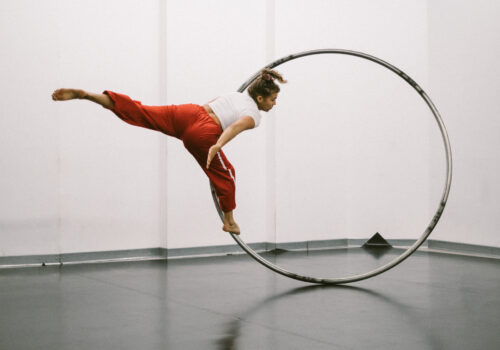
Josefina Colli was born in Badia Blanca, the province of Buenos Aires, Argentina, in 1990. Influenced by a family of plastic artists, she decides to study visual arts teaching in the city, but at the same time she discovers the circus, exploring different disciplines until she encounters the Cyr wheel.
In Badia Blanca, she establishes the “L’enlairament” company, which will receive the support of the Fons Municipal d’Arts on various occasions, including for the “Entre nos” Cyr wheel production, in 2018.
Self-taught for years, she decides to grow artistically and travels to Europe where she attends the courses of the FLIC circus school in Turin, Italy. She continues her training and, seeking to expand her corporeal expression, she attends the Area Dansa Barcelona contemporary dance school, in Barcelona, where she now resides.
Following learning, research and development of both disciplines, she asks herself: How to create and develop a personal language where both disciplines can cohabit and articulate without evolving into a hierarchy?
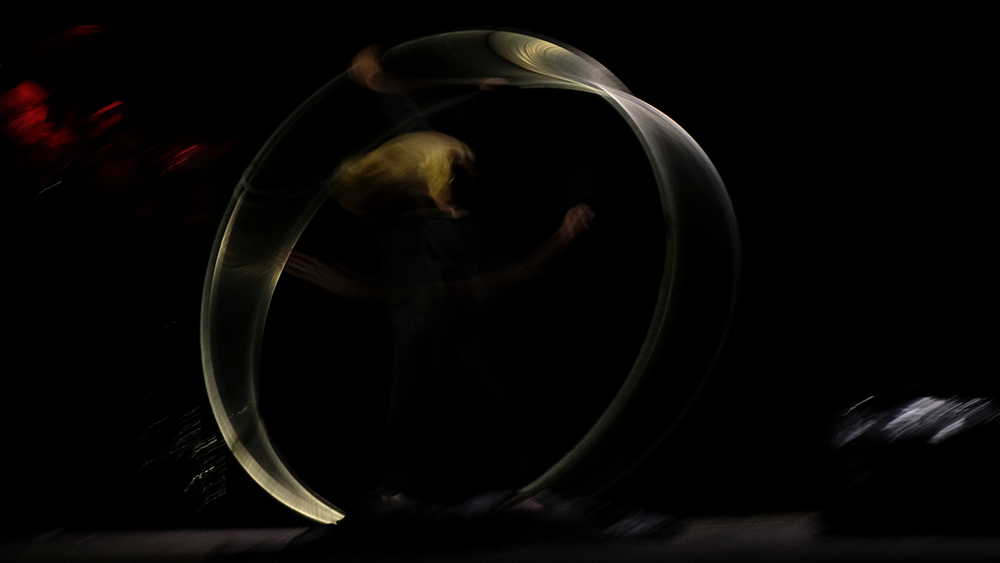
“Poética salvaje” questions and investigates the relationship that exists, and still doesn’t, between the motion delivered through dance and the Cyr wheel, analyzing each of them separately, in order to bring them to the question-action: how can they be interwoven to find the retronourishing instant, flux and coexistence of both techniques, leaving aside the hierarchization and betting on democratization?
A constant dialogue stemming from a visceral place that has its origins in unanswered questions, poetic writings and antonyms, which could deserve organizing or not, but maintain the body-object in constant feedback, creating a free place without massacres where the body-object presents itself as a guarantee of the most concrete, of a movement truth.
A research work that receives its inspiration and nourishes from different dance writers and philosophers, as well as circus-dancers who talk about the body, the game and instant composition.
From a young age she’s been interested in stage arts, exploring dance and theater, to later discover the circus through the Center for Aerial Arts, in Santiago de Chile. Once she decided to make the circus her professional life, she trains at FLIC Scuola di Circ (2015-2017) and L’ecole de Cirque in Lyon (2018-2020), specializing in hand to hand.
She became part of the Michele & Francisca company, being co-author of the SIGNES performance, which toured in different formats between 2020 and 2022.
Currently she’s part of the COLLETTIVO COLLETTIVOM, with the Mariage performance (premieres in 2024), and the Q||MƎRA COLLECTIVE within REQUIEM -research for a non-organic performance.
Interested in music as a self-taught artist, she conducts audio research and musical creation using voice and a loop station. Also, she is part of the semi-professional, feminist choir “L’ebranleuse”.
Made it to the end and now I’m at the beginning again.
“La primera y la última” is a thrilling, agitated and impatient creative process designed to give way to a mutant and transformative artistic experience.
Driven by the desire to rediscover myself on stage as a legitimate and artistically expressive body, I welcome this creation within the “essential research” program, a time to lose myself inside a space for experimenting and tearing.
Breaking down and rebuilding the languages I had previously used, to dive into a liquid and unstable means of expression where delimitations between each language are blurred.
Music, voice, movement, margins, political body, dizzy, new imaginary: a part of the threads that will interweave during the search.
Could be that all this is a good description of what I’m trying to do, considering that possibly, it will be the complete opposite.
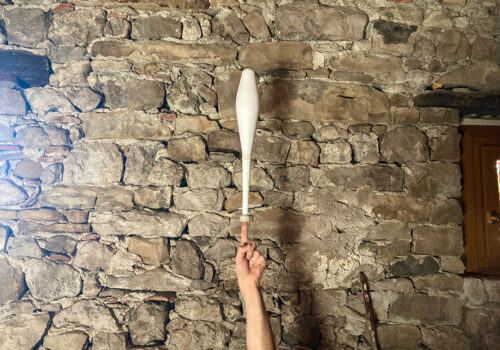
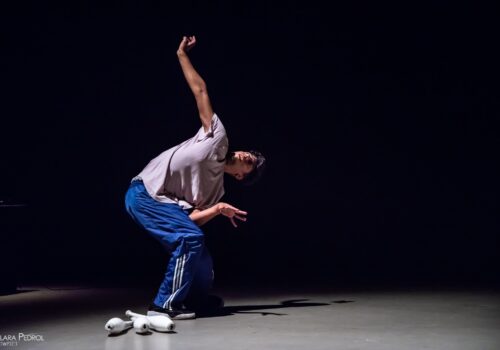
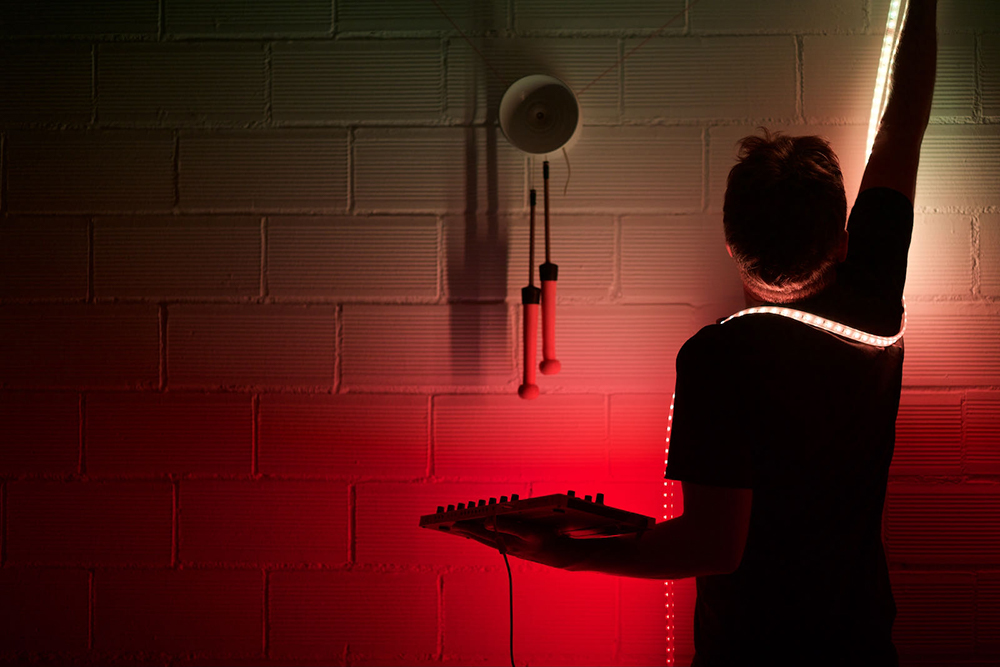
For some time now I have been quite obsessed with ambient music and the generative systems that many sound landscapers use to reach new horizons and textures. After researching a lot about generative music, I decided to do the same with juggling, and look in the direction of a couple of subgenres that I currently call Ambient Juggling and Generative Juggling.
Ambient Juggling is an unpretentious juggling, it is an act that has as its engine the constant dissolution, it exists without having to stand out with respect to the environment. Generative juggling goes a step further, trying to understand the whole environment as a system that gives inputs and receives stimuli, and based on all these parameters it evolves towards unplanned places, but they can be bounded. Polychromatic Void is more aimed at “generative juggling”. Create a system between juggling, juggling, video, music, lighting, code and other elements, where everything is connected and in a constant dialogue.
Imagination, as the etymology of the word indicates, is often based on image via sense of sight. The mental projections we make from memory are necessarily supported by images. But from sound we can also create new imaginary spaces. Can thinking through sound lead us to other realities? How can body and sound interact to search for them?
In this inquiry, the artist aims to find improvisational tools based on sound as a stimulus and to expand the possibilities of this interaction between sound, body, thought and emotion through technology. Around this concept, he will build guidelines that will serve as the starting point for a new creation revolving around the duality of breath and the networks of our lives.
Where will you end up? Is there only one last cell separating you and the dizzying precipice outside? If someone is in a museum looking at a painting, is that person the witness? Or is the witness inside the painting? Can reason only set things right in times of calm – or can it also do so during a crisis?
The height of crisis is the point where impulsivity brings us to the most absurd atrocities as forms of resolution: shooting, running, poisoning, humiliation; letting go of the leash; hitting, dying, living. But what is really more absurd: a calm world or one in crisis?
‘Epidermis’ is an attempt at personal research; to escape the void by entering the void – an attempt to stop writing so pedantically, to fuse the subject with the object, to survive this absurdity through the absurd – and attempting to accept the crisis.
Animus Anima talks about being molded and cohabited by a pairing of energies that can take different names: hot/cold, outside/inside, ying/yang, feminine/masculine. It talks about his relationship with society, with preconceptions, with standards of beauty and social pressures. Submissive to an evolution which pushes it to go backwards, this being lives a true freeing in front of the public, making a comeback to the primitive.
An autobiographical research conceived as a cheerful provocation, to build complicity with the audience through humor. Through the pole, a place where everything merges and acquires a sense. And through the Disco Dance, discipline that embodies speed and exhibition in front of a jury, represented here by the audience itself. All this will be in order to show to what extent the judgments and the social pressures lead this being to transform, embellish and camouflage obsessively its body, until falling into a grotesque aesthetic.
Foto: Alian Richard
The acrobatic body has the dizzying ambivalence to exhale its extraordinary abilities while denouncing how fragile it is.
Circus training that focuses on difficulty and aesthetics with maximum control of vertigo creates a body of super hero: successful and coherent with current capitalism, adapted to the market. The most frequently asked questions in training are related to how to be effective and safe. Effective, successful… such capitalistic words. How do you train when what you are looking to share on stage is fragility and not super-powers? What are the possible places for precariousness, or for monstruosity, or for simplicity? What scenic and training strategies or particular conditions allows an artist to be able to induce, create and live vertigo situations, so that they can physically share them on stage? Finally, what is the poetic and artistic power and the social interest in doing that today?
To carry in your mind and body all those thoughts and delusions that attack your head when you want to fall asleep. Those who go deep into the cortex and expand through insomnia. Those which end up expanding uncontrollably if you ignore them…
I take the opportunity to stop (for a little while) and to take some air. Press the brake and catch impulse, towards nowhere… to keep walking in a changing body, in a stunted world.
Boredom.
I see it, it’s there by my side,
Sitting on the same sofa as me.
He stands there, quiet and calm with a cup of tea, says nothing, but looks at me.
I love him, and he loves me too.
We love us.
Now Time has come too.
He is very clear about it.
We are a super trio.
Resolution of the second call for Trànsits 2026 and “Barcelona Crea Grants – Creation Factories”
Open registrations for the P.L.A.T on November 20 with Cia. Croma and Luis Mantilla
Resolution of the call for the Transits Residencies 2026 and the ‘Barcelona Crea Grants – Creation Factories’
Open call to participate in CirCulem 2026/2027
Open Call – Trànsits 2026 Residency Program, supported by the ‘Barcelona Crea Grants – Creative Factories’
Resolution of the 2025 Iberescena Program Call for Proposals
MEDIATION